Monday, 19 March 2012

The River Lathkill is Back

After a couple of weeks off for good behaviour we were back on the trail of the missing River Lathkill.
On the way there we encountered rain then a snow blizzard. By the time we parked up at the west end of Lathkill dale it had almost stopped raining.We set off along the well worn footpath, although it was a bit wet.
Just a couple of fields in the rocky ground gets a bit tricky to walk over being wet and slippery. It was especially tricky for the two old uns me and Geoff.
Difficult terrain over the rocks

Relief at getting through the rock field.
 After we got past the rock field area it was a lot easier to navigate the footpath.

This is a beautiful Dale.


Me on the dry bed of the Lathkill Dale cave.

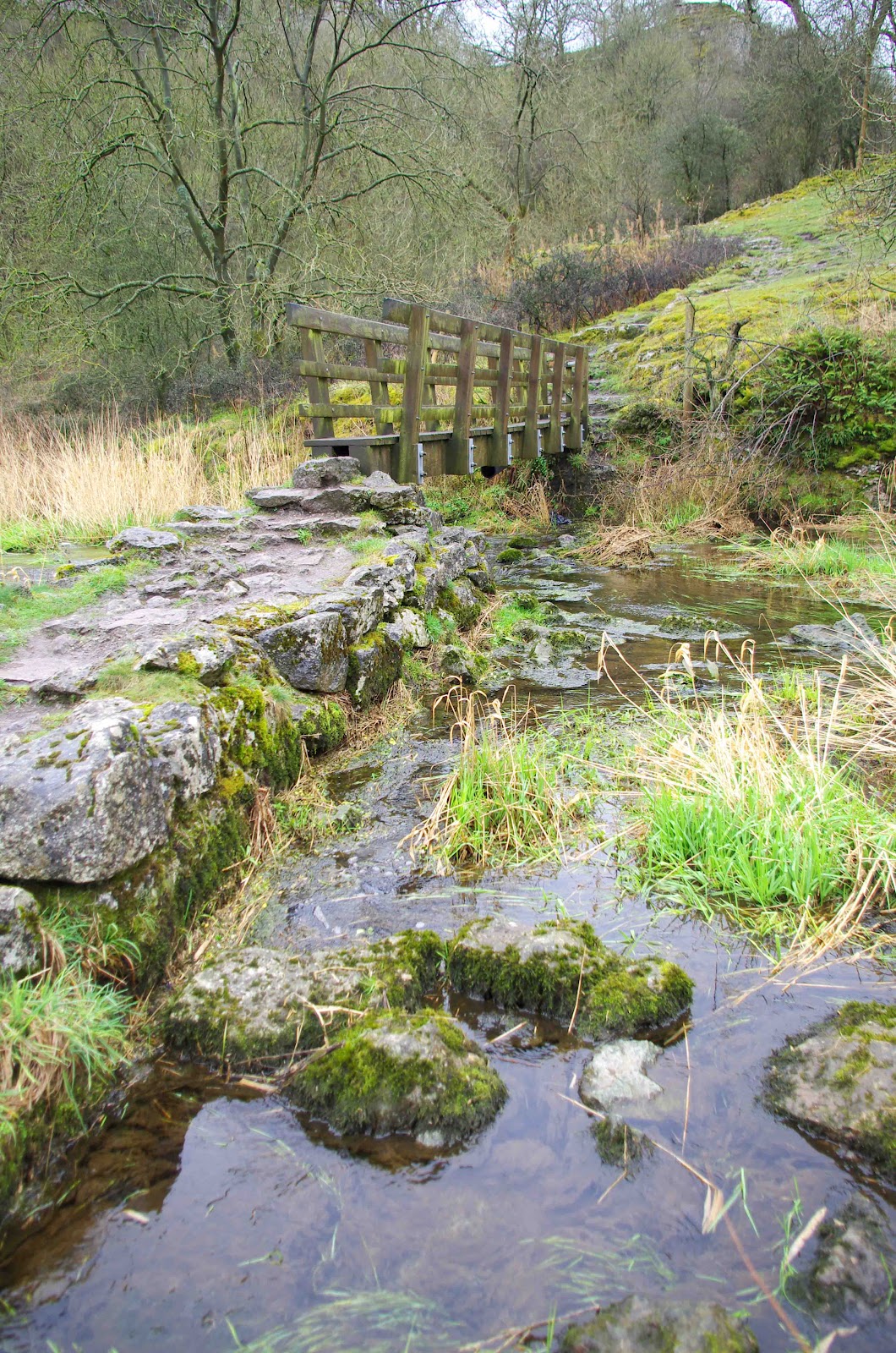
Footbridge

Geoff squeezing through a style

Dipper posing for a pic

One of the many waterfalls on the Lathkill


Don't know what this is all about.

Footbridge at Batemans House.
Water in the Mandale Sough

Some body's been busy.

This is our breakfast stop in previous visits.

The bridge at Carters Mill with a small amount of water flowing through.

The ground around the Carter Mill bridge was covered with these lovely plants.

The sluice gate was open and made the river look very odd.

The weirs on the Lathkill

Geoff waiting for our lift.
Well we just wanted to see if the river was back and indeed it is. There was no water coming out of the cave , but it soon appeared further downstream. There was even a bit of standing water in the Mandale mine sough and a little coming out of the between Carters Mill and the weirs. It was odd to see the water channelled through the sluice gate on the second to top weir. After the grim start with the rain and snow it turned out to be a good morning.
Roll on next week.


Monday, 27 February 2012

Derwent & Howden Dams


This week we decided to go and have a walk around the North Derbyshire reservoirs to see how full they are.
We set off at about 6:40 and arrived at a parking area just a hundred metres away from the Fairholmes visitor centre, unusually we were not the first ones to park up, there were 5 cars already in residence. Its just a short walk up to the Derwent Dam which is at the south end of Derwent reservoir. These reservoirs The Howden, The Derwent and Ladybower all supply water to most of Derbyshire and parts of South Yorkshire and Nottinghamshire.

Derwent Dam
 The construction of the dams was started in 1901 and finished in 1912. The huge blocks of stone were transported from Bole Hill quarry near Grindleford on a specially created 7 mile long standard gauge railway. After providing a million tons of stone the quarry was closed in 1914 with the railway shortly after. To accommodate the army of workers a small temporary town was built. With workers and families the town grew to a population of almost 1000. Most of the buildings were constructed using corrugated metal sheets and hence it became known as TINTOWN. Its proper name was Birchinlee and it had everything a normal town has, a cinema, canteen, post office, hairdressers, school and a pub. Unfortunately some workers died during the construction and they were buried in the churchyard at nearby Bamford.
West Tower of the Derwent Dam
 The dams were used by the RAF in 1943 where 617 squadron (The Dambusters) practised there low level flying and bombing techniques they used on the Ruhr dams in Germany. There is a small museum dedicated to the 617 Squadron in the west tower of the Derwent Dam.

We walked past the Derwent Dam which houses the 617 Squadron Museum and just a few metres away we saw this memorial to Pip the sheepdog.


Memorial to Pip the sheepdog
Tip and his 81 year old master Joseph Tagg went out walking on Howden Moors but were reported missing in December 1953. It was 15 weeks later after the worst of the winter when they were found and Tip was miraculously still alive lying next to his master. 
We carried on and eventually spotted Howden Dam in the distance. We passed a couple of notice boards giving information about Birchinlee (Tintown) then we left the footpath and went down to the reservoir edge and followed the bank around to the dam. .

Derwent reservoir

Derwent reservoir

Howden Dam in the distance

Geoff looking at the notice board for the Birchinlee "Canteen"

Rob & Ike reading about Birchinlee
We had a couple of obstacles one of which was a small brook. Brother Rob decided it wasn’t that small and ran at it and tried to jump it, big mistake. Unfortunately I only had time to snap the after event, he got his feet wet and dented pride
Brother Rob in the ditch

Rob photographing Howden Dam

Howden Dam 

Rob in front of the Dam wall
Me at the Howden Dam
Me at the Dam
Great spot for breakfast, but very noisy
The water was pouring over the dam wall and what the photo’s don’t give is the deafening sound of falling water, awesome.
Ike snapping away

Rob snapping the West Tower

Rob in front of the dam wall, gives a bit of scale

West Tower Howden Dam

West Tower Howden Dam

Top of Howden Dam

Water pouring over Howden Dam with a deafening roar.
We had our breakfast here, did a few more pics then it was back down the road to the car. We walked about a mile and spotted this guy on this “Ski” type form of transport, it looked good and he was going at a fair rate. Shortly after that we caught the Sunday Dam bus and got back to the car.

Off the bus and head for the car.
A cracking morning having walked about 5 miles and although the light was poor at least it wasn’t cold.
See you next week
Cheers


Monday, 20 February 2012

Cromford canal part 2

One of our party had to get back early to go to a surprise birthday party at lunch time, so we thought we would do a bit more along the Cromford canal, starting from where we left off last week. This 6 mile stretch of the canal between Cromford and Ambergate has been given the status, Biological Site of Special Scientific Interest.
We parked opposite the historic John Smedley Mill factory in Lea Bridge and walked down to the canal. The footpath led us to where the Wigwell aqueduct meets the Lengthmans cottage.
North end of the Leawood tunnel
Wigwell Aqueduct with the Leawood pumphouse on the right.
Wigwell Aqueduct last week - what a difference.
There were Pen and Cob swans "twitterpating" in the basin at the start of the Wigwell aqueduct, and the courtship display was amazing to watch.
Cromford Wharf shed with the swans in the foreground.
Rob taking a pic of the  swans in front of the Wharf shed.
From the aqueduct we walked along the old track bed, where we had to negotiate a large fallen tree.
Rob being eaten by a tree
Nice crisp morning
Geoff photographing the railway bridge over the river Derwent.
We passed an old structure which Geoff recognised as the roof of an old railway building which he had photographed in 1963. We had to cross the river at this point and got a few nice railway track shots.
South end of the Leawood tunnel
The footbridge and cast iron aqueduct over the railway track
Ike at an old railway hut.
Ike helping Geoff onto the footpath.
Footpath, aqueduct and south end of the Leawood tunnel
 This cast iron aqueduct over the railway track is where we turned back last week. We walked a bit further south towards the Gregory tunnel where the canal goes through the hillside.
Footpath & cast iron aqueduct.
Newly erected bat boxes
Lovely stretch of the canal with these reflections of the trees.
Rob over an outflow.
This is the76 yards long Gregory tunnel
 from the Gregory tunnel we climbed over the canal and up the footpath towards Lea Hurst.
The boys getting stuck in a deer gate.
 We stopped for breakfast in the shadow of Lea Hurst. This was the family home of the Nightingales where Florence Nightingale spent her summers. She nursed her mother there in the 1880's. For many years the house was a Royal Surgical Aid Society rest home and is now a private residential house.
Breakfast with Lea Hurst in the background.
There were a few roe deer just grazing across the other side of the field, so i had a go at "stalking" them, didn't get to close, but got a couple of decent snaps.

Its OK its only Jim with that bloody camera!!
Rob trying his luck with the deer.
Lea Hurst - The summer retreat for Florence Nightingale.
The historic John Smedley Mill site.
John Smedley and his partner Peter Nightingale set up his spinning mill in 1784 in the village. The brook that runs through the village provided all the power needed for his factory.
This has been a lovely crisp morning for a very pleasant walk along the Cromford canal.
The sun is rising a lot earlier now so the alarm clock will be getting changed for next week.
Cheers for now.